
Business Next / Reported by Kuo Tsai-hua
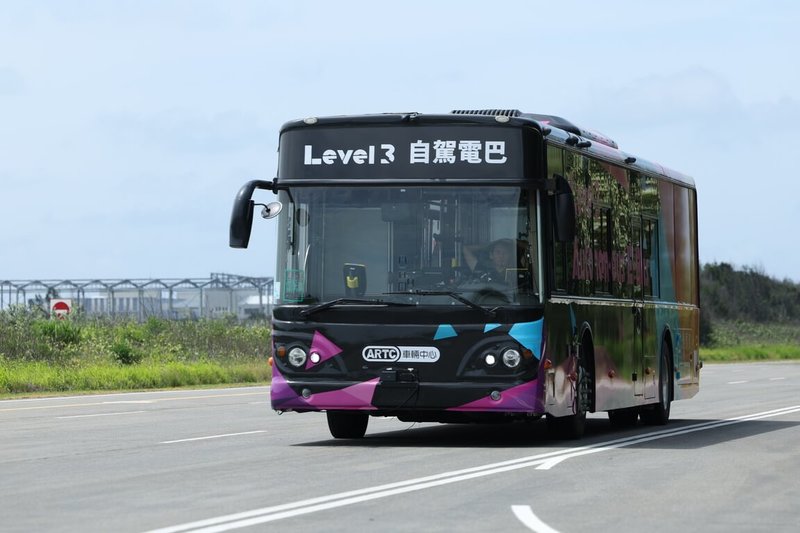
Taiwan's first Level 3 AI self-driving electric bus was built in collaboration with leading domestic companies including ELAN Microelectronics, oToBrite, CubTEK, Rotatech, DFI Inc., Arcadyan Technology, and ChiMei Motor, and utilizes the electric bus platform of Master Bus. (Photo provided by ARTC)
Can you imagine an electric bus with no human behind the steering wheel that not only drives itself but also steers smoothly around obstacles, detects driver fatigue, and even safely stops automatically? These technologies are no longer science fiction; they are now being realized in the latest Level 3 self-driving electric bus tested at the Automotive Research and Testing Center (ARTC).
On May 27, Digital Times visited the Automotive Research and Testing Center (ARTC) in Changhua Coastal Industrial Park (CCIP) to participate in the "2025 Automotive Center Research and Testing Tour." In addition to the debut of the first Level 3 self-driving electric bus in the world, it also showcased a smart cockpit system and electronic rearview mirror analysis system capable of analyzing driving behavior.
"With the rapid development of vehicle electronics and AI technology, the functionality of smart vehicles continues to upgrade. This transforms cars from simple means of transportation into highly intelligent vehicles," said Wang Zhengjian, Chairman of the Automotive Research and Testing Center. While the public's impression of ARTC used to focus on vehicle crash inspections and testing, it now provides new types of verification for smart vehicles and the industry chain, also reaching into the development of autonomous driving technology.
The first Level 3 self-driving electric bus in the world, which integrates the sensing systems inside and outside the vehicle and meets international standards
One of the highlights of the visit was the public debut of the first Level 3 self-driving electric bus in the world. This electric bus, which meets the UN R157 standard and has Level 3 autonomous driving capabilities, combines AI, autonomous driving, and information and communications technology. It was jointly developed by the ARTC and leading domestic automotive and ICT companies such as Master Bus, ELAN Microelectronics, Chi Mei Motors, DFI Inc. and Arcadyan Technology.
The electric bus utilizes the chassis of a domestic Master electric bus, while its core autonomous driving technology was independently developed by ARTC. This utilizes image recognition and radar sensing technologies, along with decision-making control software, perception fusion, driver takeover assessment, and risk response capabilities. These technologies enable the bus to keep in lane, perform autonomous obstacle avoidance, and driver monitoring.
ARTC Vice President Liao Xuelong further explained that the Society of Automotive Engineers (SAE) categorizes autonomous driving into levels 0 to 5, with the key difference between Level 2 and Level 3 autonomous driving technologies being the transfer of driving control.
At Level 2, the driver still needs to control the steering wheel and keep their eyes on the road at all times, and the vehicle only provides driving assistance. However, at Level 3, the system can take the lead in driving under certain conditions, and the driver can temporarily shift his eyes. The driver only needs to re-intervene when the system detects a complex situation.
Faced with the increasing shortage of bus drivers, the Level 3 design of this bus aims to ease the driver's burden and reduce the risk of accidents caused by driving. Therefore, at the ARTC test site, various autonomous driving scenarios were simulated on site, including lane keeping, emergency response to vehicles oncoming, and driver incapacitation.
The lane keeping system is a basic function of this autonomous driving system, allowing the vehicle to automatically keep in lane. However, if the driver activates the turn signal, the system immediately detects the driver's intention to change lanes and enters the "lane change preparation" state. At this point, the autonomous driving system activates surrounding sensors to confirm whether there are other vehicles blocking the intended lane.
Notably, to comply with relevant regulations and safety standards, if the system detects oncoming vehicles or obstacles in the adjacent lane, it will proactively cancel the lane change until it is clear, completing the lane change safely. This design reflects the high emphasis on driving safety and compliance with regulations, and also makes self-driving technology closer to the operating logic of actual road environments.
However, this self-driving electric bus is currently still in the testing phase. In accordance with the plan of the Ministry of Transportation, it will undergo a "self-driving sandbox experiment," initially being implemented on specific routes in municipalities with dedicated bus lanes. Once testing is complete, and with the necessary regulatory revisions, Level 3 autonomous buses may be deployed on public roads.
Zhang Youlong also pointed out that Level 3 autonomous driving technology will not be limited to buses in the future; it can also be applied to regular passenger vehicles, expanding the scope of its application.
Smart Cockpit Combined wuth AI: Human-Robot Co-Driving Technology Enhances Safety
Autonomous driving requires more than the car can drive itself; it also requires the ability to collaborate with humans. At this demonstration, ARTC also introduced its "Smart Cockpit Monitoring System," which leverages AI deep learning and heterogeneous sensing systems to provide real-time assessment and dynamic response to the status of the driver.

In the field of AI smart cockpits, the Vehicle Center uses "AI deep learning image recognition technology" and "heterogeneous sensing fusion bio-radar system" to develop multiple functions such as driver monitoring, child abandonment detection, and passenger fall recognition. Photo/Provided by ARTC
The smart cockpit system can instantly detect the driver's eye line of sight, head angle, and body posture, and further analyze whether there is fatigue, distraction, or physical discomfort.
If the system determines the driver is unable to respond to an emergency, it will immediately issue an alarm and even proactively slow the vehicle, pull over, and simultaneously notify the backend to ensure the safety of the driver and passengers. Infrared sensing can still identify the driver's driving status, even if the driver is wearing sunglasses, highlighting the system's high flexibility.
In addition, the AI cockpit integrates detection technology to address common safety hazards on buses, such as children left behind and passengers falling. If a passenger falls or a child is left behind, the system will immediately issue an alert to prevent accidents.
In the future, smart cockpits will go beyond safety features. Zheng Guangqing, Deputy Manager of the ARTC, stated that future development directions also include immersive entertainment experiences, AR (augmented reality) information displays, and IoV collaboration, enabling both drivers and passengers to enjoy a smart mobile experience. Integrating cloud and simulation technologies will make the development process more efficient and significantly reduce field testing costs.
Currently, countries around the world remain conservative regarding the rollout of Level 3 autonomous driving, with no full implementation yet. However, ARTC predicts that as regulations gradually relax, Level 3 vehicles could be officially permitted on the road in specific environments within three years.
To ensure that the industry in Taiwan secures a leading position, the ARTC emphasizes the importance of providing regulatory-compliant testing sites and verification mechanisms in advance to assist domestic automotive electronics and ICT companies in completing technical certification and preparing for the critical moment of future smart transportation.
Link to the original article:
全台首輛Level 3自駕電動巴士亮相!靠AI防鬼切、疲勞駕駛:乘客不會跌倒的公車要來了?|數位時代 BusinessNext