Central News Agency / Reported by Chung Jung-feng
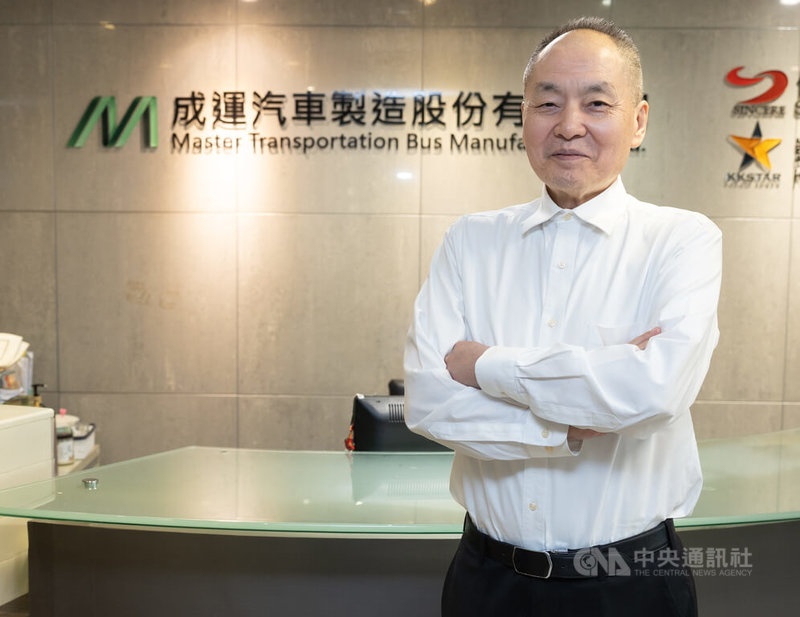
Chairman Wu Ting-fa of Master Bus stated that if electric buses are to be developed, the company must take an “unconventional” path—independently developing a complete set of domestically produced key component solutions from the outset, while taking into account the three major requirements of safety, environmental protection, and economic efficiency. (Photo by Hsieh Chia-chang, Central News Agency reporter)
Digital transformation is already underway across industries. Artificial intelligence and net-zero carbon emissions have become two major challenges facing both governments and businesses, and they are closely tied to Taiwan’s future competitiveness. The frontline reporting team of the Central News Agency provides in-depth coverage of how the government and industries of all kinds are utilizing AI to optimize production processes and drive green innovation, witnessing another leap forward for Taiwan’s industries.
Master Bus has been developing its electric bus business, and after 13 years of effort, the company is now capable of independently supplying key components of electric bus that balance safety, environmental protection, and economic efficiency. This year, its delivery volume is expected to reach the break-even “sweet spot,” giving the company a chance to record its first profit. Starting from a domestic supply chain, Master Bus is planning to do plant-export to the global market. The next step is to build a new green carbon credit business model based on its electric bus foundation.
Master Bus Takes an Unconventional Path to Build a Domestic Electric Bus Supply Chain
Chairman Wu Ting-fa of Master Bus has accumulated more than 40 years of experience in the bus transportation industry and also serves as the largest shareholder of Kuo-Kuang Motor Transport. Chairman Wu spoke at length with CNA reporters and explained clearly why the company chose a different path when it decided in 2013 to develop its electric bus business.
Chairman Wu said that through years of involvement in operating diesel bus services, he deeply felt that traditional vehicle models would inevitably need to transition to electric buses. However, at the time, the domestic supply chain was insufficient and unable to meet the future operational needs of the bus transport industry, making comprehensive transformation necessary.
Wu believes that if Master Bus were to develop electric buses, the company must take an “unconventional” route—independently developing a complete set of domestic key component solutions from the beginning, while also taking into account the three major requirements of safety, environmental protection, and economic efficiency.
Choosing this difficult and long path, Chairman Wu faced the immediate challenge of overcoming technical barriers under unfamiliar conditions, without any existing model or reference to follow.
Master Bus Handles Entire Electric Bus Production Line. Diesel Bus Production Ended in 2022
Chairman Wu said that when Master Bus decided to develop its electric bus business 13 years ago, “everything started from scratch.” From specification definition, design, testing, certification, and verification, to establishing a complete electric bus manufacturing production line, Master Bus handled the entire process on its own. To date, the company is capable of independently supplying key components of electric bus, including battery packs, main beams, chassis, motors, vehicle control units (VCU), and bus bodies.
Master Bus noted that the battery cells and battery modules that used in its electric buses adopt lithium titanate oxide (LTO) technology from Toshiba of Japan. However, the company is now able to independently design battery packs, enabling it to provide customized and cost-effective battery pack solutions based on different bus route mileage requirements. Master Bus can also provide battery management system (BMS) solutions, and its in-house production rate for battery solutions of electric bus has reached 50%.
In addition, Master Bus has independently designed and manufactured motor power systems, inverters, and drive controllers. Orders for these components began mass production in the second quarter of this year, mainly for use in the new intercity electric bus models of Master Bus.
Wu Ting-fa also said that since 2022, Master Bus has stopped producing diesel buses, bringing an end to its 24-year diesel bus production line. This year, the company’s Pingtung plant is capable of producing 1,000 electric buses annually, along with component production lines to meet demand in Taiwan’s electric bus market. Meanwhile, a new automated plant in Changhua has an annual production capacity of up to 2,000 buses, and its component production capacity can supply parts for up to 10,000 electric buses for overseas markets.
Master Bus Boosts Electric Bus Deliveries. First Profit Expected This Year
Master Bus noted that since delivering its first batch of low-floor city electric buses in Chiayi City in 2020, operations have expanded to nine major cities across Taiwan until August 17 this year. The total operating mileage of its low-floor electric buses has exceeded 35 million kilometers. With 500 buses delivered nationwide, accounting for about 24% of total 2,093 electric buses in Taiwan. The company estimates that orders for low-floor city and intercity electric buses will reach nearly 300 units this year.
Chairman Wu revealed that after nearly 13 years of investment in the electric bus business, the company has “a chance to achieve its first profit this year,” reaching the sweet spot of break-even. He also expects that after 7-meter medium-sized electric buses join operations in 2026, Master Bus’s profitability will continue to grow, with the company targeting entry into international markets in 2027.
Tariffs Favor Plant Export of Electric Bus Solutions for Global Market Expansion
Looking ahead to long-term operational goals, Chairman Wu said that Master Bus hopes to establish a domestically developed electric bus supply chain in Taiwan. On one hand, the company aims to expand from city and long-distance bus services into broader transportation and tour bus sectors within Taiwan. On the other hand, it plans to do the plant export solutions of electric bus to overseas markets.
Chairman Wu noted that in the taiwanese market, the government has set a goal of fully electrifying approximately 28,000 buses nationwide by 2030. This means about 2,000 buses will need to be replaced annually. With clear central government policies and active promotion by local governments, operators are encouraged by incentives such as subsidies, reduced fuel expenses, and lower maintenance costs. Although some operators are still adjusting their mindset toward electrification, Chairman Wu remains optimistic about the growth pace of Taiwan’s electric bus industry and hopes the government will accelerate the development of public power infrastructure.
Regarding overseas markets and tariff issues, Chairman Wu analyzed that “tariffs may actually be Master Bus’s biggest advantage.” Since the company independently develops complete electric buses and key components, its solutions are well-suited for plant exports. This approach can establish shorter electric bus supply chains around the world and allow customization according to local market needs. In addition, Master Bus’s electric bus plant export model complies with U.S. regulations such as the National Defense Authorization Act (NDAA), the Buy America Act (BAA), and the Inflation Reduction Act (IRA), as well as requirements for sourcing approved U.S. steel and battery cell materials.
Chairman Wu also revealed that investment teams from Southeast Asia, the United Kingdom, and other European companies have been in ongoing discussions with Master Bus. The company is currently working to obtain European E-mark certification for its vehicles and components, targeting the European Union and about 90% of the global electric bus market.
In terms of its presence in Paraguay and South America, Chairman Wu pointed out that Paraguay has become Master Bus’s preferred overseas investment location for low-floor city electric buses. The main reason is that establishing a factory there allows tariff-free operations, while Paraguay’s participation in the Mercosur (Southern Common Market) provides mutual tariff exemptions within the region. Additionally, local assembly of components and export to South American markets can also benefit from zero tariffs.
Master Bus’s Next Step: Creating a New Green Power Carbon Credit Business Model
Chairman Wu believes the Mercosur (Southern Common Market) region has strong potential for promoting the electric vehicle industry globally. He explained that most of the areas in South America rely heavily on hydropower and other renewable energy sources as their primary electricity supply. Operating electric bus services in the region could therefore help local businesses in Paraguay to obtain more green energy carbon credits.
In the domestic market, Master Bus is currently discussing a green power carbon credit operating model with tour bus operators. Chairman Wu pointed out that for the intercity electric coach, the accumulated daily mileage and the carbon reduction achieved per kilometer can be calculated and converted into green energy benefits. Since tour operators are unable to apply for carbon credit certification on their own, Master Bus could assist tourism businesses in obtaining carbon credits through the accumulated mileage of electric buses.
Chairman Wu added that Master Bus’s electric buses can penetrate major application areas in Taiwan’s intercity coach and tour bus industries, further developing a new green power carbon credit operating model. This approach could help Taiwan generate a large volume of carbon credits while also supporting export-oriented industries that need to purchase carbon credits. In the future, Master Bus also plans to expand related carbon credit operations in international markets such as Paraguay, South America, Europe, and the United States, creating additional global highlights for the company.
Link to the original article:
AI淨零/成運電巴供應鏈拚整廠輸出 打造綠色碳權營運新模式 | 產經 | 中央社 CNA